
Don't Start a SIP Until You Check These Mutual Fund Factors
Past returns can mislead you. These checks reveal the real quality of a fund.

Hello and welcome back to The Finance Lens!
When we start investing through SIP, the first thought that comes to our mind is:
“Which mutual fund should I invest in?”
Many of us search for the fund that gave the highest return in the last year and start investing.
I think this is where we make our first mistake.
A good mutual fund is not always the one that gave the highest return recently.
The real question is:
Can this fund create wealth consistently for the next 10 years?
Before choosing any mutual fund, these are the things I personally check.
First, understand your goal
Before selecting a fund, I ask myself:
“Why am I investing this money?”
Is it for retirement?
Children’s education?
Buying a house?
Or long-term wealth creation?
The time period matters a lot.
If I need money in the next 2–3 years, I would not depend on equity mutual funds because markets can fall anytime.
But if my goal is 10 years away, short-term market movements become less important.
Good investing needs time.
Don’t choose a fund only because it gave high returns
This is probably the most common mistake.
A fund gives a 40% return in one year, and everyone starts talking about it.
But one good year does not tell the complete story.
I would rather choose a fund that has performed reasonably well for many years than a fund that became popular suddenly.
I check:
5-year performance
10-year performance (if available)
Performance during difficult market periods
Consistency matters more than one lucky year.
Compare the fund with its benchmark
Every mutual fund has a benchmark.
The benchmark helps us understand whether the fund manager is actually adding value.
For example:
If a fund gives 14% return and its benchmark gives 13%, the fund manager has created some additional value.
But if the fund gives almost the same return as the benchmark and charges higher fees, I would think twice.
Sometimes a simple index fund can be a better option.
I always check how the fund behaves during market falls
Many investors only look at how much a fund earns when markets are rising.
But I believe the real test comes when markets fall.
During a bad market:
Does the fund fall much more than others?
Does it recover faster?
Does the fund manager take unnecessary risks?
A fund that protects money during difficult times can create better long-term results.
Because losing money hurts more than missing some extra gains.
Look at what companies the fund owns
Before investing, I like to know where my money is going.
I check:
Which companies are in the portfolio?
Are these businesses financially strong?
Is the fund investing only in one sector or theme?
A mutual fund is ultimately investing in businesses.
Good businesses usually create better long-term wealth.
Don’t ignore expenses
Expense ratio may look like a small number, but over 15–20 years it can make a difference.
A lower cost means more money stays invested.
However, I don’t choose a fund only because it is cheap.
A good fund with slightly higher expenses can still be better if it delivers consistent results.
Don’t buy too many funds
Many investors think:
“More mutual funds means more safety.”
But this is not always true.
Sometimes different funds own the same companies.
Instead of buying 8–10 funds, I prefer having a few good funds that match my goals.
Simple is usually better.
How long should we stay invested?
Equity mutual funds need patience.
The market will not go up every year.
There will be:
Corrections
Crashes
Bad economic periods
During these times, many investors stop their SIP or withdraw money.
But wealth creation happens when we give good investments enough time.
For equity mutual funds, I prefer thinking in terms of 7–10 years, not 1–2 years.
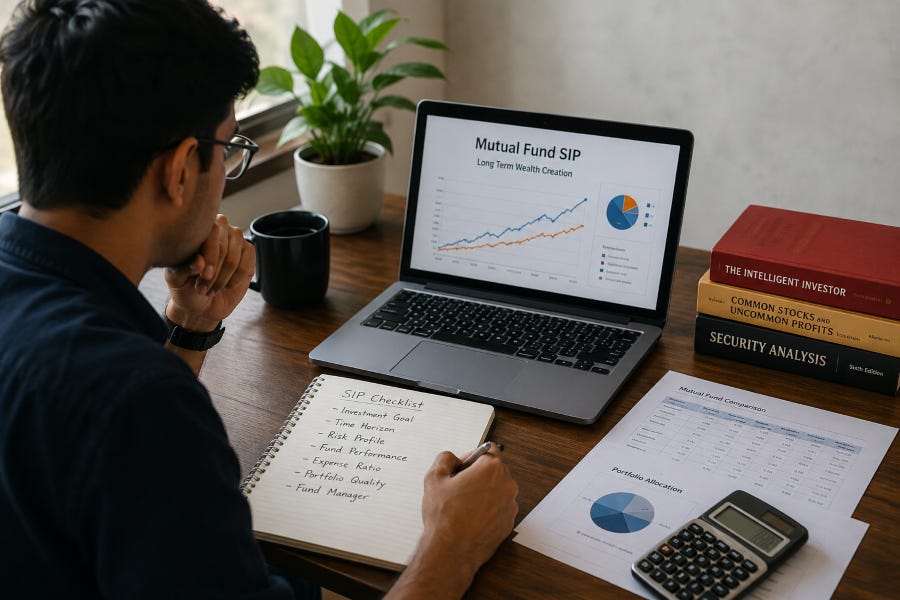
My simple checklist before starting a SIP
Before investing, I ask:
Do I understand this fund?
Does it match my goal?
Has it performed well across different market cycles?
Is the portfolio made of good companies?
Are the costs reasonable?
Can I stay invested for many years?
For me, the best mutual fund is not the one that is number one today.
It is the one that I can understand, trust, and hold patiently for a long time.
Because in investing, patience and discipline usually create more wealth than chasing the next big winner.
I also have a Sunday publication called Money In Real Life, where I explore the human side of money, our habits, fears, daily decisions, and the psychology behind why we spend, save, avoid, or get stuck.
It’s not about tips.
It’s about clarity, about seeing money the way it actually shows up in real life.
A new piece goes out every Sunday.
If you feel this could truly help you, you can check it out here.
See you next week with another lesson worth exploring.
– Smita 💚
Finance Notebook is a reader-supported publication. If you enjoy practical investing insights and thoughtful finance articles, consider becoming a free subscriber. Your support helps me continue creating content that simplifies investing and helps us all become better long-term investors.
Would be good if you could have mentioned what are the different costs one needs to keep an eye on and what they mean or stand for.
Good read. The goal is the most important point to start with. Based on the goals and its horizon, the selection of the category can be done.