
From Fields to Fortune: How to Analyze India’s Agriculture Sector
A grounded look at how India’s farms, dairies, and agri-businesses are evolving—and what investors can learn from this quiet transformation.

Hello and welcome back to The Finance Lens!
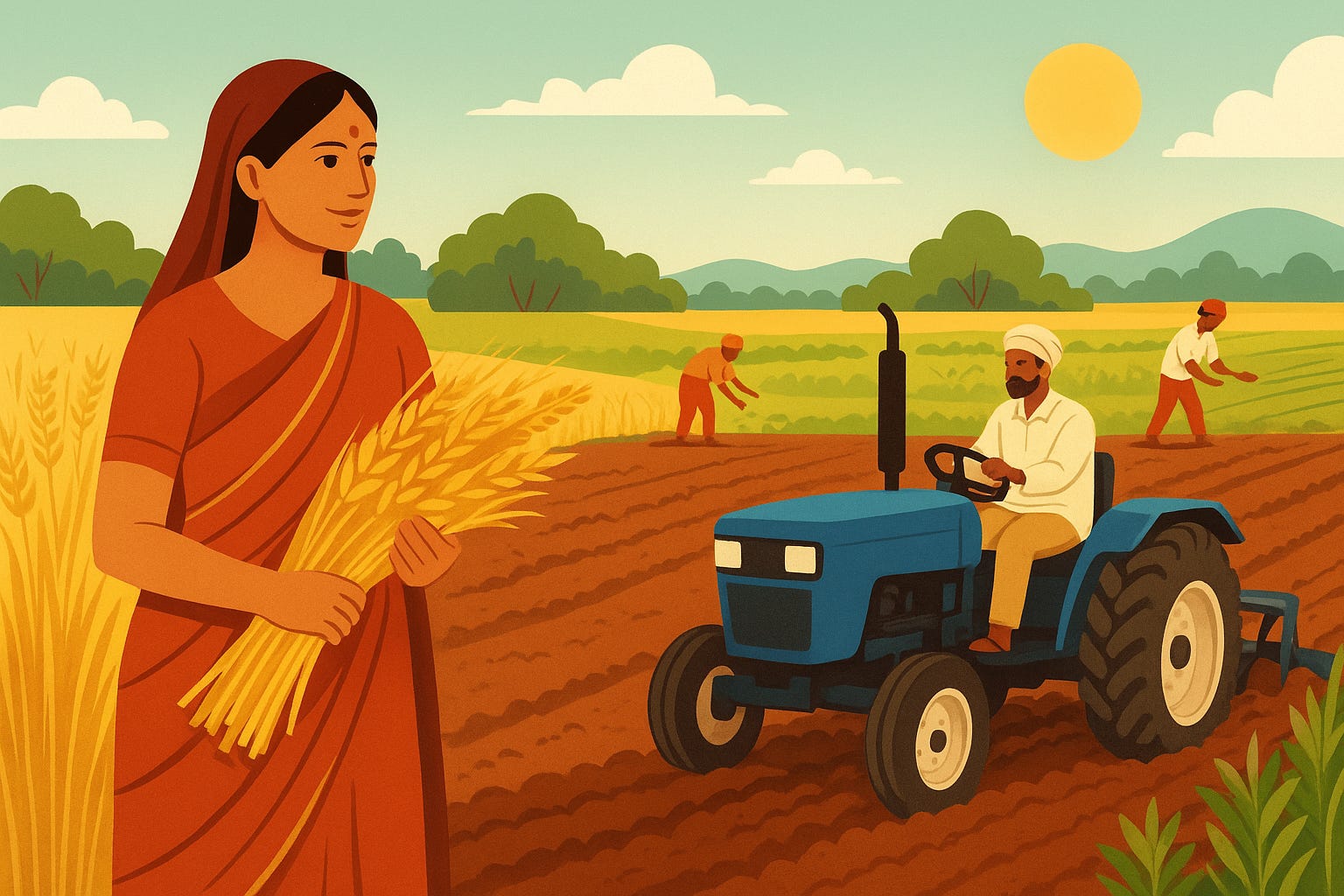
You know, we often get caught up talking about India’s booming tech sector or manufacturing growth. But the real story — the one that still touches almost every home — begins in our fields. From dairy farms to fisheries and food processing units, agriculture quietly keeps this country running.
In this post, I wanted to take a closer look at the Agriculture and Allied Industries — what is really driving it, what is holding it back, and how to understand it from an investor’s lens. I have also added a few personal reflections along the way, because you can’t really talk about Indian agriculture without a bit of heart in it.
Let’s start from the ground up — quite literally.
What We Will Cover Today
Before we dive in, here is a quick look at what this article walks through:
Understanding the Sector: What exactly falls under Agriculture and Allied Industries — and why it is still the heartbeat of India’s economy.
Key Growth Drivers: The real reasons this sector is evolving — from government policies to rising agri-tech adoption.
Challenges on the Ground: The problems that don’t always make headlines but shape the sector’s future.
How to Analyse It: The key ratios and financial metrics that reveal whether a company is genuinely strong or just lucky with the monsoon.
Major Players & Outlook: A look at leading companies, future trends, and where the next opportunities might lie.
Management & Investor View: How to judge management quality, and who this sector really suits from an investment point of view.
So, if you have ever wanted to understand how India’s oldest industry is quietly reinventing itself, you are in the right place. Let’s get into it.
Don’t just read once—stay connected. Subscribe for free to get thoughtful insights, fresh ideas, and more stories like this in your inbox.
What Is This Sector Really About?
Agriculture in India is not just about growing crops anymore. It is a mix of farming, livestock, fisheries, and even food processing — all bundled together under what we call the Agriculture and Allied Industries sector.
What makes this sector fascinating is how deeply it is woven into everyday life. According to IBEF, it still provides a livelihood to nearly 45% of India’s population and contributes roughly 18% of the country’s GVA. It is big, complex, and surprisingly adaptive.
My grandfather used to run a small dairy business in a village in Gujarat. Every morning, I remember him saying, “You can’t go hungry if you are close to the soil.” Back then, I didn’t think much of it. Now, watching how this sector is transforming with technology and global trade, it hits differently — he was right.
What’s Driving Growth?
This is not the sleepy, old-fashioned sector it once was. A lot is happening quietly beneath the surface.
Government Support: Schemes like PM-KISAN, crop insurance (PMFBY), and the Digital Agriculture Mission are trying to stabilise farm incomes and modernise rural India.
Processed Food Boom: People want convenience now — ready-to-eat meals, organic snacks, cold-pressed oils. That’s creating a whole new wave of food startups and agri-processing units.
Exports: India is already one of the top exporters of rice, spices, and seafood. There’s a global appetite for Indian produce, especially in Africa and the Middle East.
Agri-Tech: Drones monitoring crops, soil data analytics, AI-based irrigation systems — tech is slowly finding its way into fields.
Sustainability Shift: The next big wave is going to be climate-smart farming. Buyers around the world are looking for sustainable, low-carbon food sources — and that could be India’s edge.
What’s Holding It Back?
Of course, it is not all smooth. Agriculture in India still has its share of old wounds.
Small Farms: Most holdings are too tiny to make large-scale mechanisation practical.
Rainfall Dependency: Monsoon still decides the mood of the market — a bad one, and everything from crop yield to rural demand suffers.
Supply Chain Gaps: Ever wondered why onions go from ₹20 to ₹120 overnight? It is often due to poor storage, wastage, and middlemen.
Price Volatility: Commodity prices swing fast, sometimes faster than crypto.
Limited Access to Credit: Banks have improved reach, but informal lending is still a huge part of farm financing.
How Do You Judge Companies in This Sector?
When you start studying agri companies — whether fertiliser manufacturers, food processors, or farm equipment makers — a few key ratios matter more than others.
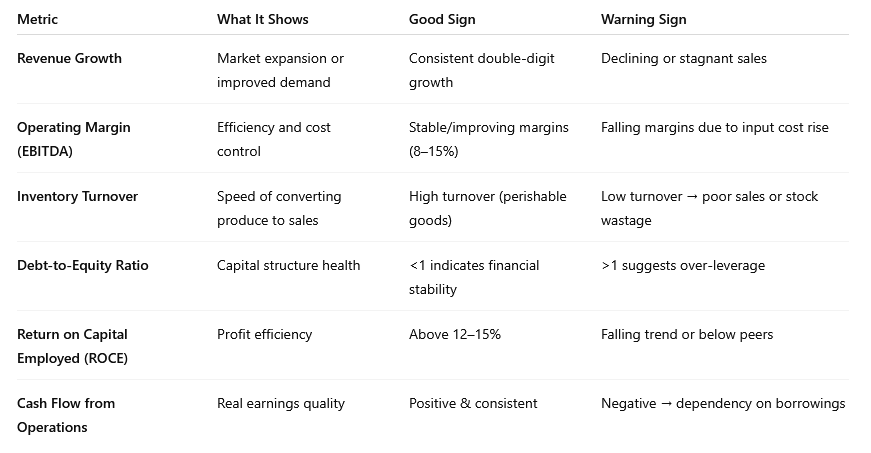
A good company will usually show steady margins, strong ROCE, and good cash generation. When any of these start slipping, take it as a signal to look deeper — sometimes margins fall because of rising raw material costs or poor pricing power.
The Big Players
A few names always pop up when you talk about agri and allied sectors:
UPL Ltd. – A global player in crop protection with solid R&D.
Coromandel International – Known for its fertiliser business and strong farmer connect programs.
Godrej Agrovet – Diversified into animal feed, dairy, and agri-inputs — very balanced and tech-friendly.
These companies have something most others don’t — scale, distribution, and the trust of millions of farmers.
Where Is It All Headed?
The next decade could be transformational for Indian agriculture.
Government Focus: Policies are shifting from subsidies to value creation — storage, exports, and processing.
Tech Integration: Drones, IoT, and AI will become more common on farms.
Allied Segments Growing Faster: Fisheries, dairy, and food processing are now expanding at a quicker pace than crop farming.
Export Potential: With global food shortages and shifting supply chains, India can become a major exporter if logistics and quality control improve.
In short, the long-term story looks strong, but execution remains key.
Management Matters
If you are investing, look closely at the people running the show.
Have they handled tough years well?
Are they transparent with investors?
Is the promoter holding steady or falling?
A good sign is when management focuses on value addition, sustainable growth, and tech adoption — not just expansion for the sake of it.
The Investor’s View
If you are a long-term investor, this sector deserves a place on your watchlist. It is not going to deliver overnight returns like a hot IPO, but it can give steady compounding if you pick the right players.
Short-term investors might find it too unpredictable — monsoons, government policy changes, and commodity prices can all mess with quarterly numbers.
But if you believe in India’s rural and consumption story, agriculture and allied sectors are like the foundation stone — quiet but essential.
Final Thoughts
India’s farming is a strange mix of old and new. Some farmers do things exactly like their fathers did. Others? They are checking crop prices on their phones or watching YouTube for tips on soil and seeds.
Whenever I go back to my village, I see it everywhere — people trying stuff, learning, figuring out little ways to make their land better. Makes you realise something: real change doesn’t happen in offices or big cities. It starts quietly, in the fields, with people who have been working the soil for generations.
So next time you think about India growing, just remember — it literally grows from the ground up.
Thanks for spending time with The Finance Lens! If this helped, subscribe for free to stay up-to-date with our insights. And if someone in your circle could also benefit from this, share it with them—because investing wisdom grows stronger when it is shared.
Perfect and much needed analysis.
Future belongs to Agriculture.
Even we can explore businesses like ITC who are concentrating on "Farm to plate" concept.
ITC supports farmers though farming and procures the produce and
* Process it as AATA
*Makes biscuits, chips etc..
*Also they have cloud kitchens that prepares food and delivers through quick commerce in the name of "ITC Master Chef Creations".
Nice Analysis 👍