
How to Read an Income Statement
Discover how revenue, expenses, and profit reveal a company’s real growth and efficiency, not just the headline profit number.

Hello and welcome back to The Finance Lens!
Profits up 25% - nice headline. Not the whole story.
Most investors stop at that shiny number. But profit growth on its own is a half-told story.
Did revenue actually rise, or did the company just trim costs? Was the boost repeatable, or a one-off accounting quirk? Those are the questions that separate headlines from facts.
The income statement holds the answers - if you know how to read it.
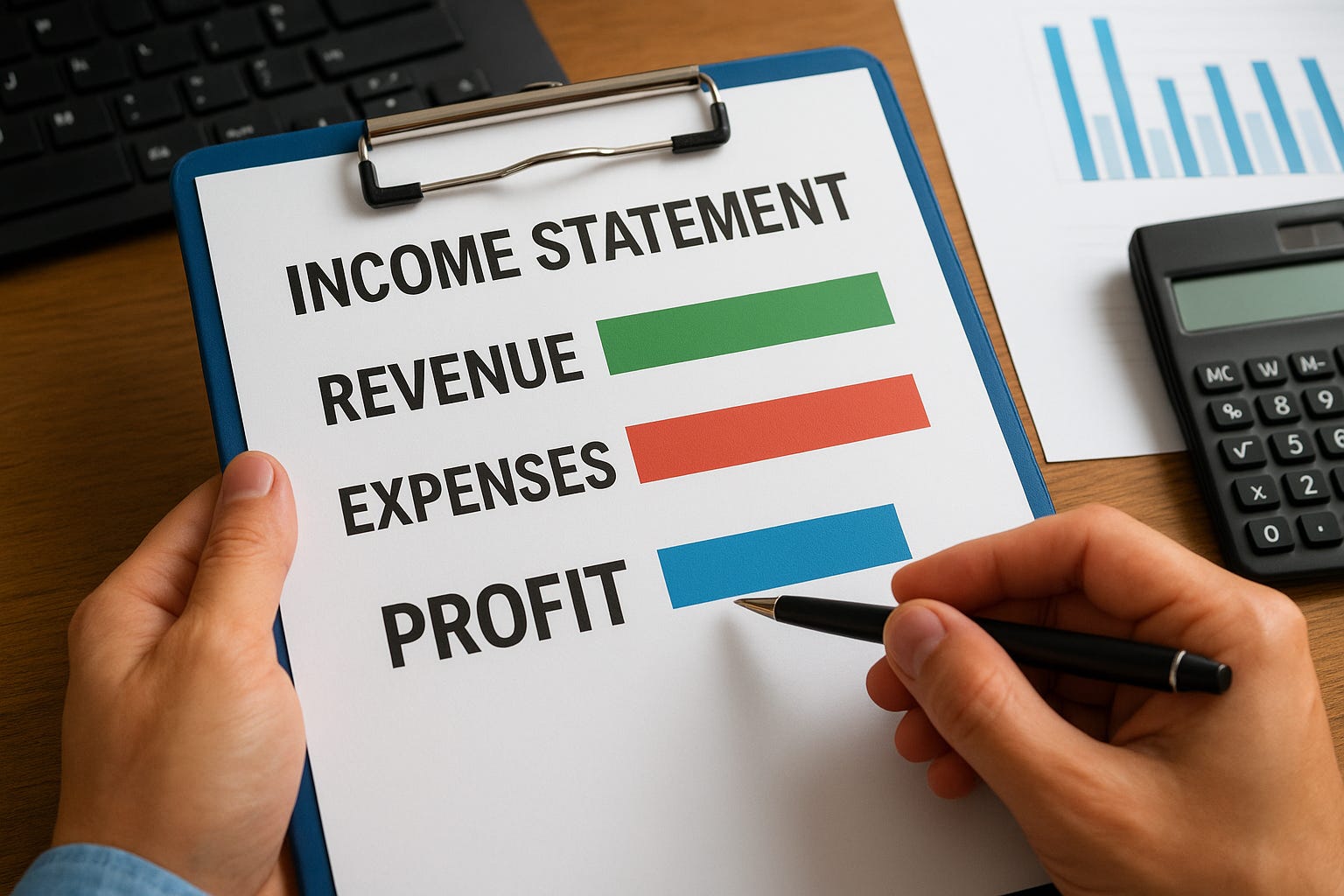
In this post, we will walk the ledger from top to bottom: Revenue → Expenses → Profit, and show what each line really says about a company’s growth, control, and efficiency. No jargon, just what matters.
By the end, you will be able to spot the difference between genuine profit growth and a headline that is trying to impress you.
Let’s unpack it step by step, like an analyst, but without the snooze button.
Don’t just read once—stay connected.
If you are enjoying this piece, tap the ❤️ or hit “Repost” to share it with your Substack friends—it helps more curious readers discover this community.
And subscribe for free to get thoughtful insights, fresh ideas, and more stories like this straight to your inbox.
What We Will Cover Today
What the income statement really tells you (in plain words)
How to read revenue, expenses, and profit like an analyst
What each line says about growth and efficiency
A small “try this” task to practice on your favourite stock
1. The Income Statement - The Company’s Life in Three Lines
At its core, the income statement is just this:
Revenue → Expenses → Profit.
That is the whole story. Everything else is commentary.
Revenue - The Top Line
This is where the money comes in.
But do not stop at “sales up 20%.” The real question is — how?
Did they sell more units (volume growth)?
Or just raise prices (price growth)?
Did new products drive sales or just heavy discounts?
If revenue is rising but margins are falling, it is like running faster with a hole in your fuel tank. You will reach nowhere soon.
I once got excited about a mid-cap consumer company showing 30% sales growth.
Looked great - until I noticed their advertising costs doubled and margins had halved.
Lesson learned: growth without control burns cash, not builds wealth.
Expenses — The Middle Layer
Expenses are the “control” test. They tell you if the management has discipline.
Every line—employee costs, raw materials, rent, marketing—is a clue.
If costs rise faster than sales, the business is losing efficiency.
If costs stay stable while sales rise, that is the mark of a company learning to scale.
Think of it this way: Revenue shows ambition, but expenses show maturity.
Profit — The Bottom Line
This is where everyone’s eyes go — the famous “net profit.”
But analysts care about what is behind that number.
Operating profit shows core business strength.
Net profit adds finance and tax impact.
EPS (Earnings per Share) tells you what each share really earns.
The trick is to check profit margins over time. Are they consistent? Growing? Or slowly eroding?
A company that grows profit but loses cash flow might be good at storytelling, not business.
2. A Real Example (Because Numbers Need Faces)
Take Hindustan Unilever (HUL) — one of India’s most consistent performers.
Between FY20 and FY24, its revenue grew steadily, around 8% a year.
Nothing flashy. But its operating margin stayed near 23%, even when palm oil and crude prices shot up in 2022.
How? Smart mix shift.
They focused on premium brands, managed costs, and did not panic with prices.
Compare that to smaller FMCG players who saw margins crash 400–600 basis points in the same year.
Same industry, same inflation, different discipline.
That is what the income statement quietly tells you — who’s in control and who’s pretending.
3. Reflection — The Human Side of Numbers
If you strip away the fancy terms, the income statement is just human behaviour in numbers.
Revenue reflects the company’s ambition.
Expenses reflect its discipline.
Profit reflects its integrity.
Next time you see a headline screaming “Record Profits”, pause for a second.
Ask yourself: Is this growth real or borrowed from the future?
Because sometimes, the healthiest businesses do not shout — they just deliver, quarter after quarter.
#QuickChecklist
Check if revenue growth comes from price or volume.
Watch if expenses rise more slowly than sales.
Focus on profit margins, not just profit numbers.
#TryThis
Open the financials of Marico or Tata Motors.
Compare their sales growth and EBITDA margin from FY20–FY24.
You will instantly see who is managing growth smarter.
#ReaderNote
Save this post. It is your simple lens for reading business stories — not just numbers.
Tomorrow, we will go deeper into Revenue & Margins — how analysts separate real growth from optical growth.
Thanks for spending time with The Finance Lens!
If this piece helped you, tap the ❤️, share it, or repost it on Substack—it really helps our insights reach more thoughtful readers like you.
And if you have not yet, subscribe for free to stay up to date with our latest stories and insights. Because investing wisdom grows stronger when it is shared. 😊
Great article...
Hello Smita, Thank u for explaining this so nicely and in an easy way.
Also can u tell me where can i get the financial for Marico or Tata motors?