
How to Spot Overvalued Stocks
Discover how to separate long-term wealth creators with real moats from flashy hype stocks that look exciting but often disappoint.


Hi Everyone,
Now and then, the market goes crazy over a few popular stocks. They rise fast, and everyone talks about them. But that doesn’t always mean they are worth buying.
In this post, I will share how to tell the difference between solid companies with real strength (moats) and those just riding short-term excitement (hype).
Let’s get into it.
Don’t just read once—stay connected. Subscribe for free to get thoughtful insights, fresh ideas, and more stories like this in your inbox.
Every market cycle has its favourites. Some stocks suddenly become the talk of the town—everyone on social media, TV channels, and even your colleagues at work can not stop discussing them. Prices shoot up, and it feels like you will miss the bus if you don’t join in.
But here is the problem: being popular is not the same as being profitable.
What a Moat Really Means
A moat is basically a company’s long-term protection against competition. Imagine a castle with a wide ditch around it—hard to attack.
For companies, moats come in many forms:
Brands we can’t ignore (Asian Paints, Apple)
Network effects (Visa, NSE)
High switching costs (Microsoft Office, SAP software)
Cost advantage (DMart, ITC in FMCG)
These businesses don’t depend on hype. They keep selling, even in tough times, because customers find it hard to leave them.
The Nature of Hype
Hype, on the other hand, is when the story is more attractive than the numbers.
It happens when:
A company announces one big order and suddenly gets valued like a global giant.
A whole sector becomes hot (EVs, defence, renewables, AI), and even the weaker players get pulled up.
Social media and media buzz trigger FOMO, and retail money pours in at any price.
The excitement may last months or years, but if fundamentals don’t back it up, the fall is usually quick and painful.
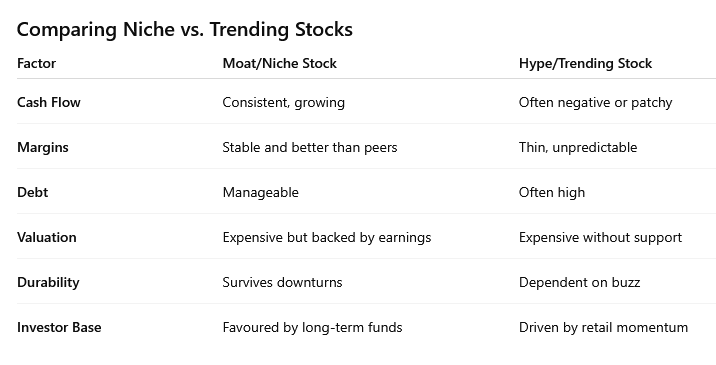
The Risk of Chasing What’s Popular
Look back at Indian markets and you will see this pattern: companies like RCom, Suzlon, and Yes Bank were once favourites but later destroyed wealth.
On the flip side, so-called “boring” companies like HDFC Bank, Asian Paints, and TCS just kept compounding quietly. The difference? Moats versus hype.
How to Tell the Difference
A few quick checks can save you from paying hype-driven prices:
Cash Conversion – Is the company actually collecting money from sales?
Margins – Are profits consistently better than peers?
Debt – Is growth funded by borrowing heavily?
Customer Stickiness – Can rivals easily lure customers away?
Valuation – Is the stock already priced as if it is the market leader of the future?
If a stock fails these checks, it is probably hype.
The Takeaway
Hype gives you excitement. Moats give you wealth.
Trendy stocks may look glamorous in the moment, but when the music stops, only those with real competitive advantages keep creating value.
Next time you see a stock racing ahead just because “everyone is buying,” pause and ask: Does it really have a moat—or is it just hype dressed up as growth?
If you found this useful, I would love for you to subscribe to my Substack newsletter—that way, you won’t miss future posts on smart investing. And if you think a friend or colleague could benefit from this, go ahead and share it with them too. Good investing grows even better when the learning is shared.