
Is Your Stock Safe? Decode Debt Before Investing
A simple guide to spotting good debt, bad debt, and hidden risks before you buy any stock.

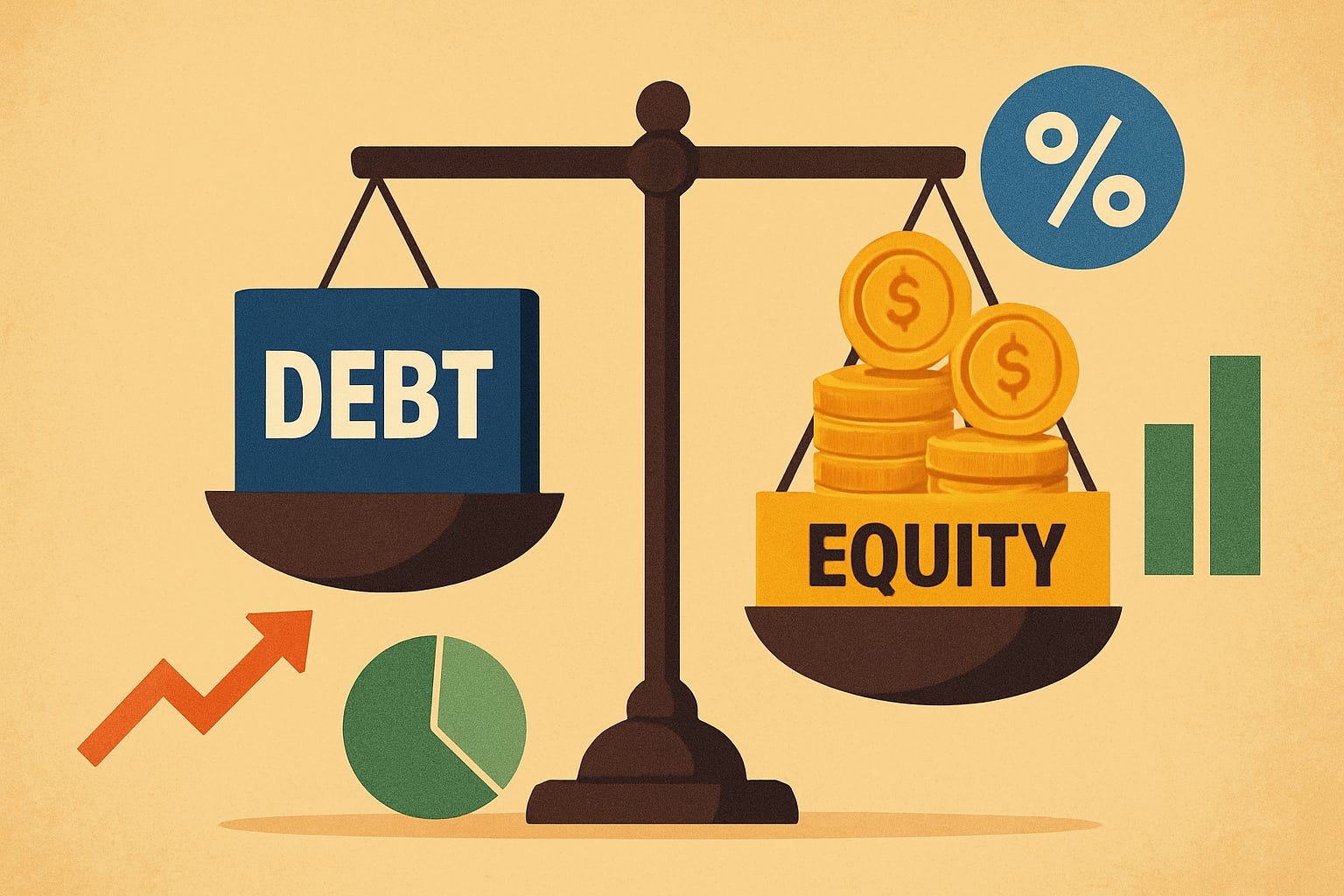
Hello and welcome back to The Finance Lens!
Quick question: Have you ever looked at a company and thought, “Man, this business is flying… I should have bought it earlier,” and then six months later the stock suddenly collapses and you wonder, “What went wrong?”
I have made that mistake once.
Years ago, I got excited about a company building new plants, launching new products, and doing interviews everywhere.
Everything looked perfect… until I checked the balance sheet after entering.
Too late. The company was basically running on borrowed oxygen.
That experience still annoys me, in a useful way.
So today’s post is simply my attempt to make sure you do not repeat that mistake.
In the next few minutes, you will see:
When debt actually strengthens a business
When it quietly becomes a ticking bomb
The two ratios analysts look at before anything else
And a simple way for you to judge any company in 60 seconds
Alright, let’s dig in.
Don’t just read once—stay connected.
If you are enjoying this piece, tap the ❤️ or hit “Repost” to share it with your Substack friends—it helps more curious readers discover this community.
And subscribe for free to get thoughtful insights, fresh ideas, and more stories like this straight to your inbox.
What We Are Covering Today
What leverage really means
Debt-to-equity: the quick balance sheet pulse check
Interest coverage: the oxygen test
When debt is useful
When debt turns ugly
A couple of simple real-world examples
A short reflection + a checklist you can save
1. When Debt Sneaks In: The Growth Illusion
There is something funny about debt. It looks harmless when business is booming…
And suddenly becomes the villain when things slow down.
Most of us focus so much on revenue and profit that we forget the basic question: “Is this company growing with its own strength, or someone else’s money?”
Let’s break that illusion and understand debt the way analysts do — calmly and without fear.
2. Decoding Debt: How to Spot When It Helps or Hurts
1. What Leverage Means
Leverage is basically this: “I do not have enough money to grow fast, so let me borrow some.”
Sometimes it is brilliant.
Sometimes it is stupid.
It depends on what the company does with that money.
2. Debt-to-Equity Ratio (D/E)
Think of D/E as comparing how much of the business is owned by the owners vs how much is owned by lenders.
Lower D/E = more control, less pressure
Higher D/E = lenders have a louder voice in the room
Analysts use this to see whether the company is standing on its own legs or on crutches.
Signals I personally look for:
Below 0.5 → mostly comfortable
Above 1 → now you need a reason
Sudden spike → either expansion or trouble
A quick coffee-shop rule I use: “If debt grows faster than revenue, something is off.”
3. Interest Coverage Ratio (ICR)
This one is super underrated.
It simply answers: “Can the company pay interest comfortably with its operating profit?”
ICR > 3 → business is breathing normally
ICR between 1–3 → it can breathe, but not run
ICR < 1 → business is gasping, lenders are worried
Almost every company that collapses financially shows trouble here long before the news comes out.
4. When Debt Is Actually GOOD
Let me be honest, debt is not the enemy.
It is more like fire.
Dangerous, but extremely useful if controlled.
Debt usually helps when:
It is used for expansion, not survival
Returns are higher than the interest cost
Cash flow is steady (FMCG, utilities, etc.)
Management is sensible, not emotional
I once met a CFO who said,
“We borrow only when ₹1 of debt can bring back ₹1.50 or more. Otherwise, we wait.”
Still one of the smartest lines I have heard.
5. When Debt Turns Dangerous
Debt becomes toxic when:
Profit slows, but EMIs do not
Cash flow dries up
Interest keeps rising
The company borrows more to repay old loans
This is how businesses look fine from the outside but panic internally.
If you ever see a company celebrating “expansion” while margins fall and debt rises — be cautious.
3. Real-World Examples
Tata Motors — A Debt Story With a Comeback
A few years back, everyone was nervous about Tata Motors’ debt. But the company quietly improved operations, increased cash flows, reduced unnecessary spending, and slowly brought debt down. The improvement was visible in the interest coverage ratio first, long before the stock moved.
Telecom Sector — When Debt Bites
Remember the days of ultra-cheap data?
Great for consumers.
Terrible for telecom companies.
High debt + falling revenue = heartbreak.
Only a couple of players survived because their cash flows could handle the debt.
Stories like these keep you grounded.
4. Lessons Debt Leaves Behind
In the end, debt tells you something deeper than numbers: How disciplined the company is.
How honest they are about growth.
How well they sleep at night, and how well you will sleep as an investor.
Next time you open a company’s balance sheet, ask one simple question: “Is this growth built on strength… or borrowed courage?”
If you get that right, you avoid 80% of big mistakes in investing.
Let’s keep learning, gently, one concept at a time.
#QuickChecklist
Check D/E → dependence on borrowing
Check ICR → ability to survive
Check cash flow → the truth behind the story
#TryThis (1-minute task)
Pick any company you like.
Google “Debt-to-Equity” and “Interest Coverage.”
Just see what story the numbers tell you.
#ReaderNote
Bookmark this — you will use it again the next time a company announces a “big expansion plan.”
Thanks for spending time with The Finance Lens!
If this piece helped you, tap the ❤️, share it, or repost it on Substack—it really helps our insights reach more thoughtful readers like you.
And if you have not yet, subscribe for free to stay up to date with our latest stories and insights. Because investing wisdom grows stronger when it is shared. 😊
“A bank lends you an umbrella in sunshine and asks for it back the moment it starts to rain.”
Debt is good for a company or an individual when they don't need it.
For Example: Tata had a cash cow named TCS to turn around TATA MOTORS, that means they had excess reserves in TCS and if TATA MOTORS failed they would have easily repaid the debt from TCS routing through TATA SONS.
So as a value retail investor better to choose a company with D/E < 0.5 or Zero.
If we go for a high debt company it should have a CASH COW.
For Example:
TATA has TCS.
ITC has Cigarette business. etc..
Yes it seems to be very conservative, but remember the 2 rules of Warren Buffet.
Rule No. 1: Never lose money.
Rule No. 2: Never forget Rule No. 1.
Great article Smita