
Mastering the Balance Sheet: A Beginner’s Guide to Reading Like a Pro
A beginner-friendly guide to understanding assets, liabilities, and equity—made simple with real company examples.

If you have ever looked at a company’s balance sheet and felt like you were reading a foreign language, you are not alone. But here’s the truth:
Reading a balance sheet is not rocket science; you just need the right lens to decode the numbers. In this guide, we will break it down step by step so that by the end, you will be reading a company’s balance sheet like a seasoned investor.
What Is a Balance Sheet Anyway?
A balance sheet is like a financial snapshot of a company at a specific point in time.
It tells you what a company owns (assets), what it owes (liabilities), and what’s left for shareholders (equity).
Formula to remember:
Assets = Liabilities + Shareholders' Equity
This balance is why it is called a balance sheet.
Part 1: ASSETS – What the Company Owns
Assets are everything the company controls that has value.
Example: Company A
Let’s say company A shows:
Cash: ₹1,00,000 crore
Inventory (unsold iPhones, iPads): ₹20,000 crore
Property & Equipment: ₹2,00,000 crore
Total Assets = ₹3,20,000 crore
Tip: Look for Cash and Receivables to see liquidity. Are they growing year-on-year?
Part 2: LIABILITIES – What the Company Owes
Liabilities are the company’s obligations, like loans, unpaid bills, or future expenses.
Example: Company A Liabilities:
Short-term loans: ₹30,000 crore
Accounts Payable (to suppliers): ₹25,000 crore
Long-term debt: ₹50,000 crore
Total Liabilities = ₹1,05,000 crore
Tip: Compare total debt to equity. If debt is too high, it may be risky—especially in rising interest rate times.
Part 3: SHAREHOLDERS’ EQUITY – The True Value Left
Think of equity as the portion of the business truly owned by shareholders after debts are paid.
Company A’s Equity:
₹3,20,000 crore (Assets) – ₹1,05,000 crore (Liabilities) = ₹2,15,000 crore (Equity)
This includes things like:
Retained Earnings (profits kept in the business)
Share Capital
Tip: Positive and growing equity over time is a green flag. It means the company is building value.
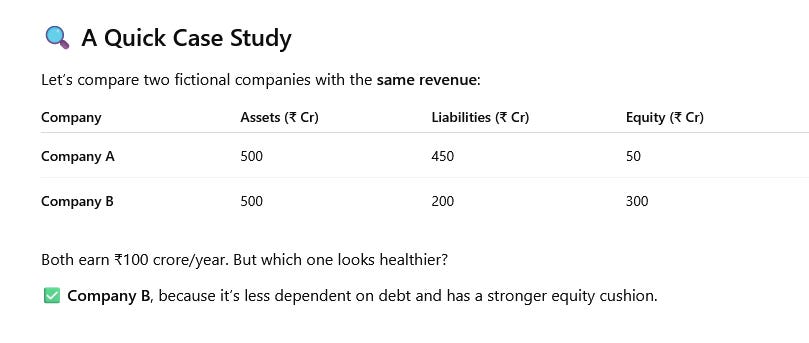
Quick Red Flags to Watch:
Equity shrinking year-over-year? It could mean consistent losses.
Debt > 2× equity? Check the interest coverage ratio next.
Huge inventory or receivables? Might signal slow-moving sales or bad collections.
Final Thoughts: Why This Matters
Even if you don’t plan to become a finance nerd, understanding the balance sheet helps you make smart investing decisions. You will spot strong companies early and avoid ticking time bombs.
And remember — the balance sheet tells you if a company is standing on solid ground.
Great article.. The tip sections is also great... Also i feel you can add mor real examples like taking company and showing actual example with screenshots so its will be more descriptive.. But the article is very good...
Insightful