
Passive vs Active Investing: Which One Actually Builds More Wealth?
Understand both approaches and learn when each one works best.

Hello and welcome back to The Finance Lens!
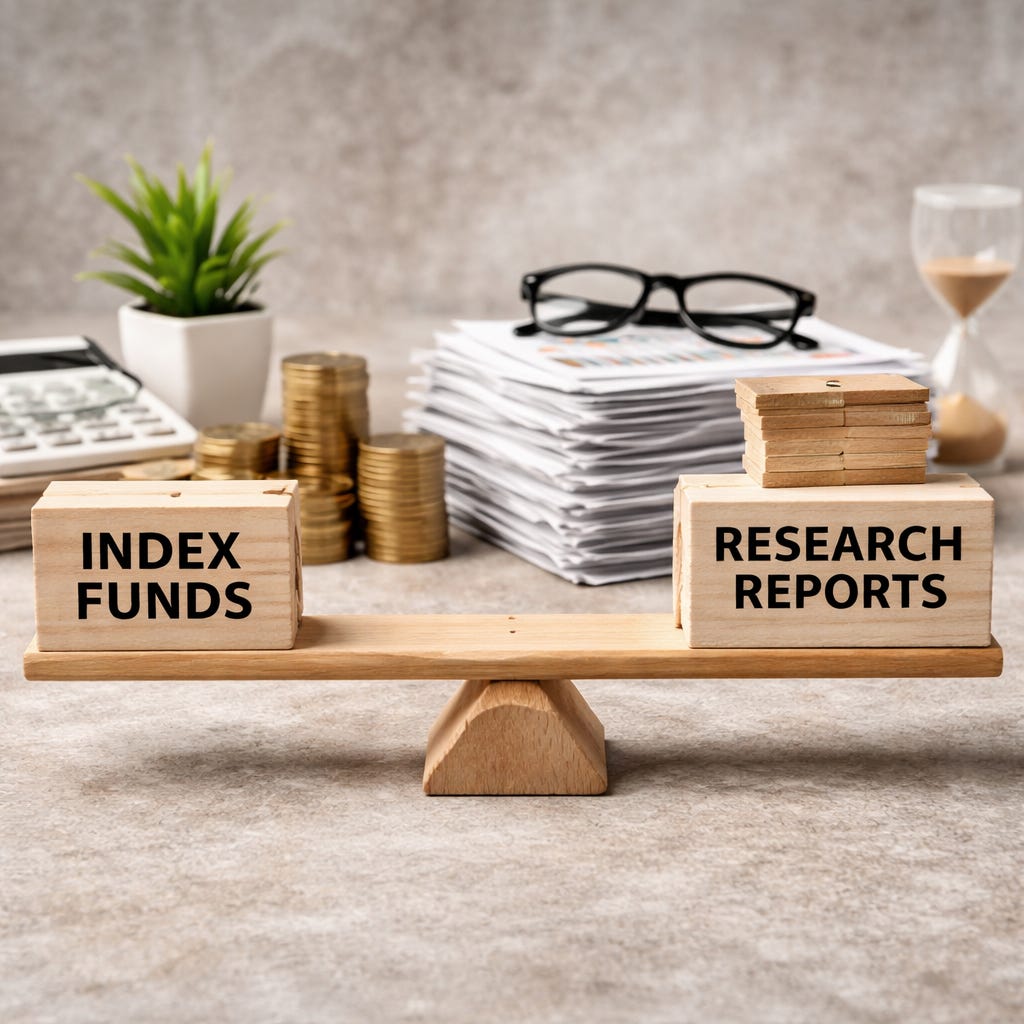
If you spend even a little time in the investing world, you’ll hear this debate everywhere:
Passive vs Active - which is better?
The honest answer?
It’s the wrong question.
Because the real edge doesn’t come from choosing one side.
It comes from knowing when to use each.
First, Let’s Keep It Simple
Passive Investing
This is the “don’t overthink it” approach.
You invest in index funds or ETFs that simply track the market, like the Nifty 50 or Sensex. No stock picking. No timing.
Low cost
Low effort
Predictable (you get market returns, nothing more, nothing less)
It’s like saying:
“I trust the market to grow over time. I don’t need to be smarter than it.”
Active Investing
This is where you try to beat the market.
You pick stocks, analyse businesses, track management, study valuation, basically do all the work to outperform.
High effort
Higher costs (time, research, sometimes fees)
Potential for outperformance (but also underperformance)
It’s like saying:
“I believe I can spot opportunities others are missing.”
The Reality Most People Ignore
Here’s the uncomfortable truth:
Most active investors underperform the market over long periods
Not because they are dumb
But because consistency is hard
Markets are competitive. Every trade has someone on the other side.
So if you are doing active investing, you are not just competing with retail investors… You are competing with institutions, analysts, and algorithms.
That’s not easy to beat.
So, Why Not Just Go Fully Passive?
Because passive investing has its own limitations.
You will never outperform the market
You are fully exposed to market cycles (including crashes)
You can’t avoid overvalued sectors or bubbles
You are basically accepting:
“I’ll take whatever the market gives me.”
And sometimes, that’s perfectly fine.
When Passive Investing Makes Sense
Passive works best when:
1. You Don’t Have Time
If you are busy with your job, business, or family, this is a no-brainer.
2. You’re Just Starting Out
Instead of trying to pick the “next multibagger,” it’s smarter to first build discipline and consistency.
3. You Value Simplicity
No tracking of quarterly results. No stress over market news.
4. You Want Predictable Compounding
Markets, over long periods, tend to go up. Passive lets you ride that trend.
When Active Investing Makes Sense
Active works when:
1. You Actually Enjoy Research
Not forced. Not FOMO-driven. But genuine curiosity about businesses.
2. You Have an Edge
This could be:
Better understanding of a sector
Ability to stay patient
Emotional discipline during volatility
3. You Can Handle Underperformance
Even good investors underperform for years sometimes.
If that shakes you, active investing will be painful.
4. You’re Focused on Long-Term, Not Quick Gains
Active investing is not trading. It’s slow, often boring, and requires conviction.
The Smarter Approach: You Don’t Have to Choose
This is where things get interesting.
Most successful investors don’t go “all in” on one approach.
They combine both.
A Practical Framework:
Core Portfolio (60–80%) → Passive
Index funds / ETFs
Stable, low-cost, long-term compounding
Satellite Portfolio (20–40%) → Active
High-conviction stock ideas
Opportunity to outperform
This way:
Passive gives you stability
Active gives you upside
And more importantly, you reduce the risk of being completely wrong.
A Small but Important Insight
A lot of people say:
“I’ll start with active investing and beat the market.”
But the better approach is often the opposite:
“Let me earn market returns first. Then try to beat them.”
Because once you understand how hard it is to outperform, you start respecting risk a lot more.
Final Thought
This isn’t about choosing a side.
It’s about self-awareness.
If you want peace of mind, go passive
If you want challenge and potential alpha, go active
If you want balance, do both
At the end of the day, the best strategy is the one you can stick with during tough times.
Because in investing, discipline beats intelligence more often than we like to admit.
If you want to understand money beyond charts…
beyond numbers…
beyond all the noise we see every day
I also have a Sunday publication called Money In Real Life, where I explore the human side of money, our habits, fears, daily decisions, and the psychology behind why we spend, save, avoid, or get stuck.
It’s not about tips.
It’s about clarity, about seeing money the way it actually shows up in real life.
A new piece goes out every Sunday.
If you feel this is something that can truly help you, you can check it out here.
Until next time,
-Smita 💚
Thanks for spending time with The Finance Lens! If this piece helped you, tap the ❤️, share it, or repost it on Substack; it really helps our insights reach more thoughtful readers like you. If you haven’t already, subscribe for free to stay up to date on our latest stories and insights. Because investing wisdom grows stronger when it is shared. 😊
Nice Post
Nice post. Over longer run churn matters. We often switch active funds and everything comes with exit costs. Passive funds don’t require that churn.
Also just curious to know, what are your thoughts on small cap index investing? It’s too wide and most times gains in one is offset by loss in others. Would SC250 passive create alpha over Nifty 50?