
Risk vs Return: The Most Misunderstood Concept in Finance
Volatility is not real risk. Here is how Infosys and Yes Bank prove that risk is about business quality—not price swings.


How confusing volatility with real risk can quietly ruin your investments
Let me tell you a story—one that plays out every year in Indian stock markets. Back in 2018, I was watching two stocks: Infosys and Yes Bank. Both were big names. Both had seen price swings. But only one of them was truly risky—and it was not the one people feared the most.
Fast forward a few years:
Infosys, despite its ups and downs, kept compounding steadily.
Yes Bank, once a darling of the markets, crashed over 90%—not because it was volatile, but because it was fundamentally broken.
That’s the trap most beginners fall into. They confuse volatility with risk. And it is one of the costliest mistakes in finance.
Let’s unpack this.
Volatility ≠ Risk. Here’s Proof.
Imagine you bought Infosys at ₹650 in 2018. It dipped to ₹600, jumped to ₹750, and dipped again. That’s volatility.
Now, imagine someone bought Yes Bank at ₹385 in 2018. It stayed calm for a while. Then—boom—plunged to ₹15 by 2020.
Ask yourself: Which one was actually riskier?
Volatility is just price movement. Risk is losing your capital for good.
Infosys was volatile, but the business stayed solid.
Yes Bank? Calm at first—but the underlying business was crumbling.
Why We Fall for the Trap
There is a reason this confusion is so common. Finance books, news anchors, and even stock screeners equate volatility with risk—because volatility is easy to measure.
What is not easy to measure?
Debt traps
Governance failures
Unsustainable growth fueled by risky loans (Yes Bank again!)
As humans, we fear what we can see, and we see charts go red. But true risk is often invisible until it is too late.
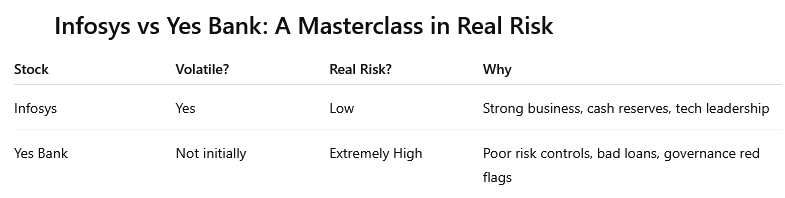
Infosys saw price swings due to global IT trends, currency, etc.—but the core business was robust. Yes Bank hid its problems behind fancy numbers and press releases—until the skeletons came out.
Return Without Understanding Risk = Just Luck
Many people who made money in Yes Bank in 2017 thought they were smart. But they were just lucky. The moment reality kicked in, luck ran out—and losses stayed.
If you don’t know what risk you are taking, you might as well be gambling.
How to Spot Real Risk (Not Just Price Swings)
Before investing, ask:
Does the company generate consistent cash flows?
Is debt under control?
Is the management trustworthy?
Are profit margins stable or growing?
Is the business model future-proof?
These questions reveal real risk—far more than a stock’s 30-day price chart.
Personal Story: The Day I Almost Bought Yes Bank
Back in late 2017, I almost bought Yes Bank. Everyone was talking about its “aggressive growth.” I opened the chart: smooth, upward, clean.
But one thing bugged me: the loan book was growing faster than its capital base. I passed. A year later, the truth exploded. That day, I understood what Buffett meant when he said: “Only when the tide goes out do you discover who’s been swimming naked.”
Final Thought
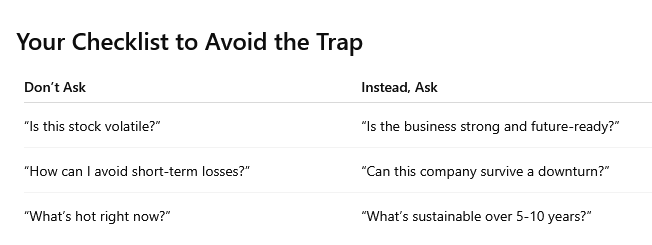
Volatility is not your enemy—it is just the market breathing. Real risk lies in bad businesses, poor capital allocation, and blind investing. The more you focus on what the business does, the less you will be shaken by what the stock does.
So the next time a stock dips, don’t panic. Instead, ask: Has the business changed?
If the answer is no, you may just have found a long-term opportunity.
Yes bank