
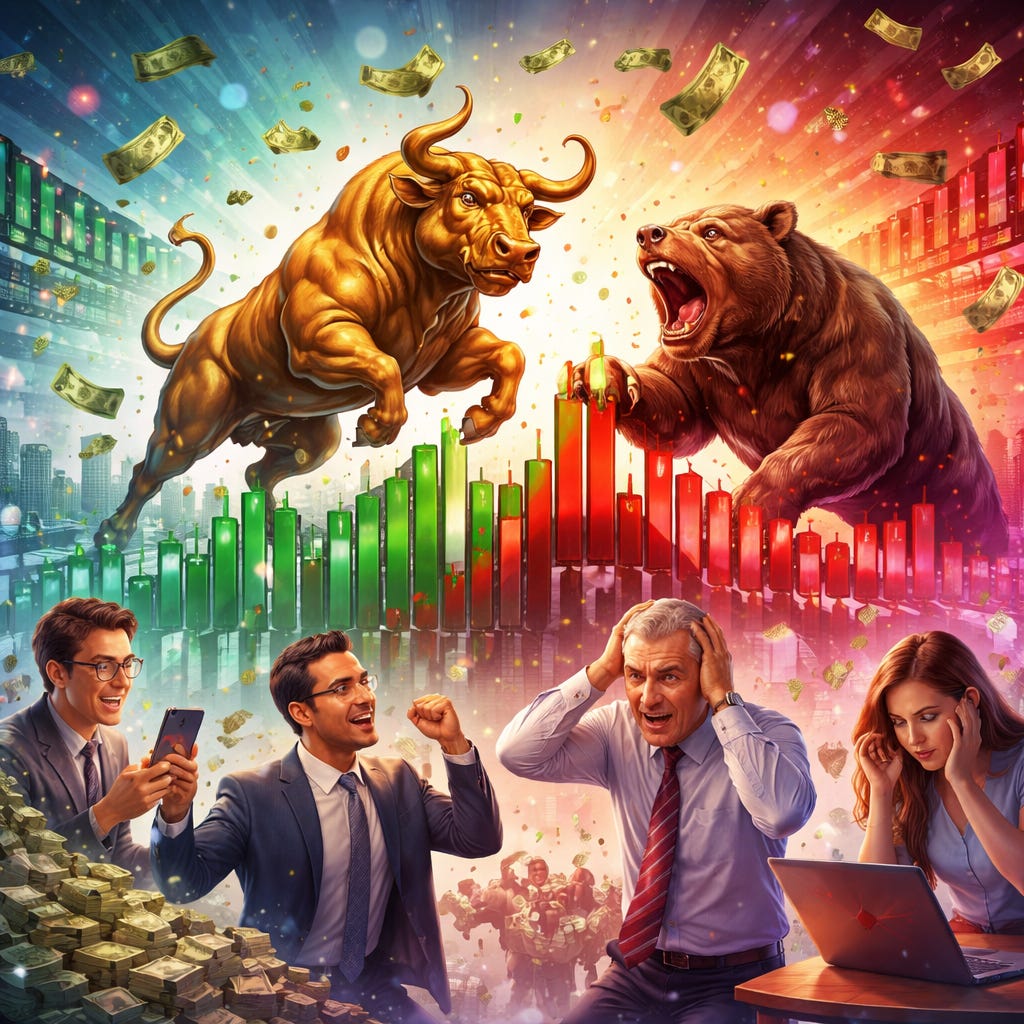
Why Fear and Greed Keep Controlling the Markets
The hidden psychology behind rallies, crashes, and the decisions investors regret later.

Hello and welcome back to The Finance Lens!
If you have spent even a little time in the stock market, you already know this:
Numbers matter… but emotions run the show.
Before I go ahead, let me say this openly: I have not been very regular lately, and I may not be fully consistent this week either because of some family commitments. Life happens. But I will be back to my usual posting rhythm from next Monday. Thanks for sticking around.
Honestly, sometimes the market feels less like a financial system and more like a giant WhatsApp group where one scary message or one hyped rumour can change the mood instantly.
For years, I believed investing was mostly about analysing balance sheets. Later, I learned the embarrassing truth: most of us do not lose money because of bad companies… we lose money because of our own fear and greed.
Let’s talk about that honestly.
Don’t just read once—stay connected.
If you are enjoying this piece, tap the ❤️ or hit “Repost” to share it with your Substack friends—it helps more curious readers discover this community.
And subscribe for free to get thoughtful insights, fresh ideas, and more stories like this straight to your inbox.
Greed: The Story Behind Every Crazy Rally
Greed does not feel like greed when you are in the middle of it. It feels like an opportunity.
You know that feeling, you are watching a stock go up day after day, and suddenly your brain whispers, “If everyone else is making money, why am I still thinking?”
I have felt it too.
The Adani Rally — Everyone Wanted a Piece
Before the Hindenburg drama, Adani stocks were flying like there was no gravity.
It was not that every business suddenly doubled its earnings overnight. It was the story of India’s infrastructure boom, energy transition, and global ambitions… and honestly, when a narrative becomes that shiny, fundamentals take a backseat.
People were not just buying the stock.
They were buying the feeling of not being left behind.
I remember someone in my own circle who said, “Boss, it is Adani. It can’t fall.”
(We all know how that turned out.)
That’s greed for you, confident, loud, and almost contagious.
Fear: The Emotion That Needs No Introduction
Fear is the exact opposite.
It is quiet at first, then suddenly everywhere.
It is that sinking feeling when you open your trading app and wonder, “Should I just sell everything?”
2008 — The Year Fear Went Global
If you were investing around 2008 or even just old enough to watch the news, you probably still remember the atmosphere.
Banks collapsing.
Markets in free fall.
People are literally crying on TV.
What’s interesting is that many companies people sold back then were not actually collapsing; investors just could not handle the uncertainty. Fear makes you imagine the worst-case scenario even when it is not logical.
I have seen friends sell great stocks during a correction… only to watch them recover beautifully a few months later. Fear whispers, “What if it goes to zero?” even when zero is nowhere near reality.
Why We Flip Between These Two Extremes
The market is basically a giant pendulum swinging from: “I am going to miss out!”
to “I am going to lose everything!”
Very few people stand calmly in the middle.
And honestly, you can not blame them. Our brains are wired to behave this way.
Loss aversion
Losing ₹10,000 feels worse than gaining ₹10,000 feels good. It is weird, but true.
Recency bias
If it has been rising, we think it will rise forever. If it has been falling, we think the world is ending.
Herd mentality
If everyone else is running in one direction, we assume they know something we don’t.
Overconfidence
This one is funny, one good trade and suddenly we all feel like Warren Buffett’s long-lost nephew.
These patterns repeat again and again. The players change, the headlines change, but human behaviour rarely does.
What I have Learned (Sometimes the Hard Way)
Here are a few things that helped me over the years, most of which I learned through mistakes:
1. Stick to a process
Not a fancy one. Even a simple checklist works.
Anything is better than reacting to every headline.
2. Accept that cycles are normal
Markets go up, then down, then up again.
It is not a problem — it is just how it works.
3. Don’t become overconfident in a rally
Rallies are fun, but they make you blind.
That’s when risks hide the most.
4. Keep some cash aside
I learned this after missing a brilliant buying chance in 2020 because I was fully invested. Never again.
5. Watch your own emotions, not just the market
Your reaction to volatility matters more than the volatility itself.
In the End… You are Not Fighting the Market — You are Fighting Yourself
Here is the real secret nobody tells you in investing workshops:
The market doesn’t punish lack of knowledge.
It punishes lack of emotional control.
Fear and greed are never going away.
They will create bubbles, trigger sell-offs, and make even smart investors behave strangely.
But if you can stay steady when everyone else is losing their mind, not perfectly, just a little bit better than average, you will already be ahead of most people.
Because the real edge in investing is not insider info or fancy charts.
It is understanding your own psychology… and not letting it control you.
A Quick Note
Many of you have asked if I can teach IPO analysis in a structured, practical way beyond hype and headlines.
I have been building a 30-day IPO Deep Dive Series, hosted outside Substack (on Gumroad), focused on reading DRHPs, spotting red flags, and analysing IPOs the way analysts do. Substack will always remain free.
I will share more details and the link soon.
If you enjoyed this piece and want to build stronger investing skills step by step, you might find these helpful:
Learn Sector Analysis – Understand how different sectors work, what drives them, and how to analyse them beyond headlines: https://theequityecho.substack.com/t/sector-analysis
Think Like an Analyst – Learn how professional analysts read balance sheets, interpret numbers, and connect data with real business stories:
https://theequityecho.substack.com/t/thinklikeananalyst
**A small personal note: I recently wrote a children’s book on gentle money habits for kids. Details are in the About section if you would like to explore 💛
*To make sure you never miss an update, please add Substack to your email safe-sender list. This helps newsletters land directly in your inbox instead of getting blocked or filtered.
Thanks for spending time with The Finance Lens!
If this piece helped you, tap the ❤️, share it, or repost it on Substack—it really helps our insights reach more thoughtful readers like you.
And if you have not yet, subscribe for free to stay up to date with our latest stories and insights. Because investing wisdom grows stronger when it is shared. 😊
Mr. Market is driven by emotions—fear and greed—not by logic or fundamentals.
Good businesses crash in bear markets. Bad businesses soar in bubbles. - In short term.
Bad businesses eventually disappoint and Good ones compound. - In long term.