
Why India’s AI & Analytics Sector Will Drive the Next Economic Leap
Discover the key drivers, risks, and opportunities behind India’s AI-powered transformation — and what it means for long-term investors.

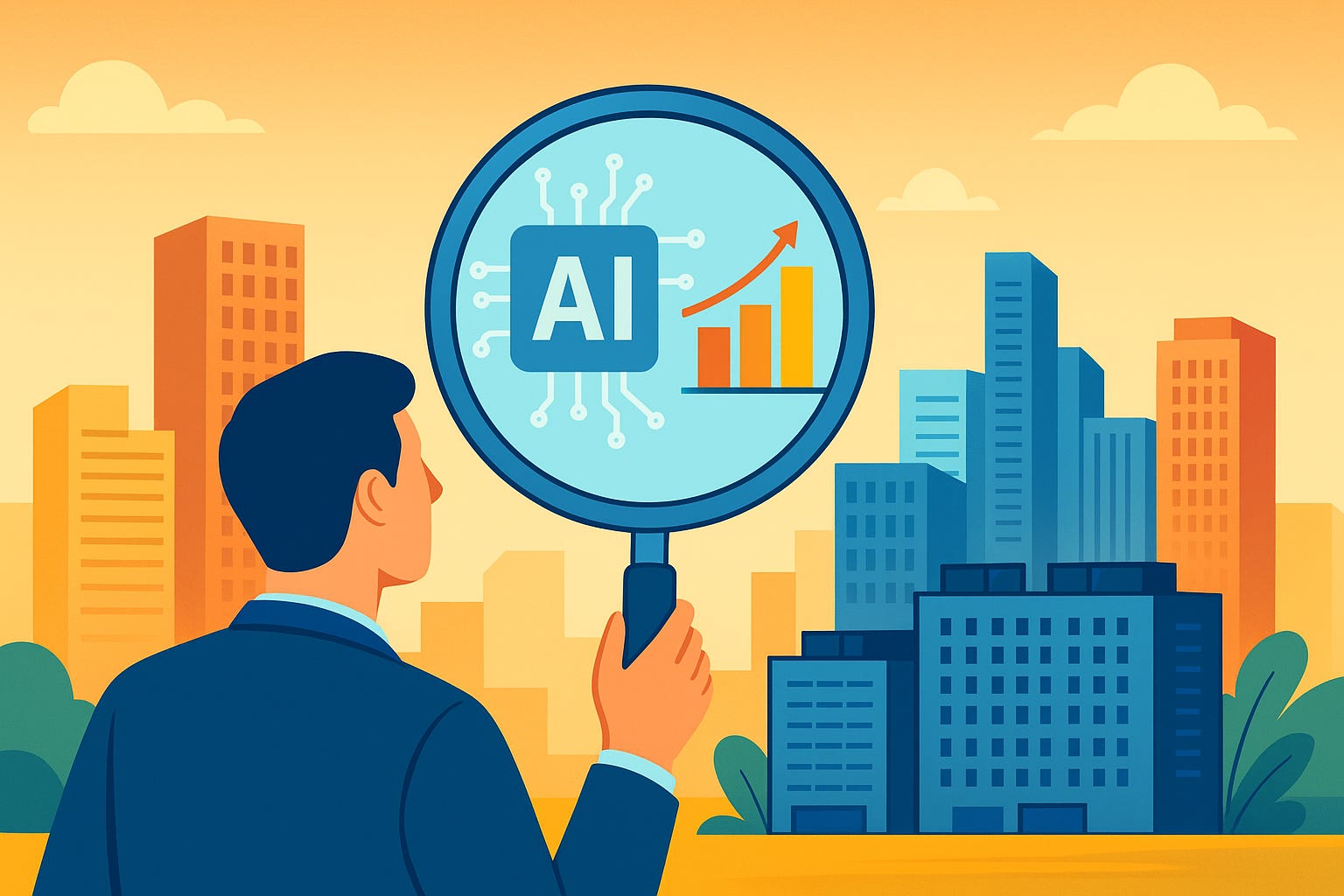
Hello and welcome back to The Finance Lens!
Lately, everyone seems to be talking about AI taking over the world. But here is a quieter story that’s just as powerful — the rise of India’s AI, Analytics & Digital Infrastructure sector. It is not just about robots or algorithms; it is about the invisible digital backbone that’s quietly shaping our economy, job market, and even the way businesses make decisions.
In this piece, I will walk you through how to analyse this fast-evolving sector — from what drives its growth and where the real risks lie, to the key ratios that actually matter and how investors can spot long-term winners.
Let’s dive in and decode how India’s digital future is being built — one data centre, one algorithm, and one smart bet at a time.
What We Will Cover Today
In this article, we will break down the AI, Analytics & Digital Infrastructure sector using a clear, practical framework — the same one analysts and serious investors rely on. You will learn:
What this sector really is — and why it matters so much for India’s growth story.
Key drivers that fuel its expansion (from AI adoption to data-centre build-outs).
The major challenges companies face include regulatory changes, talent shortages, and technological shifts.
Important ratios and metrics to track when analysing businesses in this space.
Major players leading India’s digital transformation.
Future outlook — where this sector is headed and what trends could reshape it.
How to judge management quality and alignment with shareholders.
Investor view — who should invest, what risks to watch, and how to think long-term.
Don’t just read once—stay connected. Subscribe for free to get thoughtful insights, fresh ideas, and more stories like this in your inbox.
Introduction
When people talk about “AI” or “data,” it often sounds like science fiction — chatbots, robots, or algorithms predicting the stock market. But behind all that buzz, there is a real, serious business story unfolding.
The AI, Analytics & Digital Infrastructure sector is basically the backbone of modern digital life. Think of it in three layers:
AI & Analytics — the brain that makes sense of data.
Digital Infrastructure — the body that carries the brain (servers, data centres, cloud systems, fibre networks).
Integration Services — the hands that make everything work together.
For India, this is not just another tech story — it is becoming a pillar of our economic growth. IT and related digital services already make up over 7% of India’s GDP and employ millions. With AI and cloud expansion, that share could soon touch 10%.
And here is what’s exciting: while the world races to build smarter tech, India is quietly becoming its digital workshop — building, hosting, and exporting the tools that power this transformation.
Why It Matters
When I first started tracking IT companies years ago, the talk was all about outsourcing. Now the conversation has completely changed. Today, it is about insight — who can use data better, faster, cheaper.
AI and analytics are now the secret sauce in almost every business decision — from predicting what you will buy next to optimising hospital beds or farm yields. And for a country like India, with its massive data volume and young talent pool, this shift is a golden opportunity.
At the same time, digital infrastructure — those massive, humming data centres — are quietly becoming the new factories. Instead of making cars or clothes, they process data, host cloud apps, and run AI models.
So, when you analyse this sector, remember: you are not just looking at tech — you are looking at the new economic backbone of India.
Key Drivers
What actually drives growth here? Let’s break it down simply:
Digital Adoption Everywhere
Every company now wants to go digital. Whether it is a small retailer adopting cloud billing or a bank using AI for loan approvals, digital infrastructure demand is booming. In 2024, India’s IT spending crossed US $130 billion — and that’s not slowing down anytime soon.The AI Wave
Generative AI is the new electricity. It is expected to make India’s IT sector 40–45% more productive in the coming years. That means better margins, smarter automation, and endless consulting projects.Infrastructure Boom
The data centre space is exploding. Companies like Yotta and CtrlS are building AI-ready campuses with GPU servers and liquid cooling — it is a whole new industrial revolution, just quieter (and cooler, literally).Government Push
Digital India, data-localisation norms, and PLI schemes are turning policy into opportunity. The government wants India to be the world’s “data hub,” and the incentives reflect that.Talent Advantage
The real power lies in our people. India has one of the largest pools of engineers and data scientists in the world. That’s our long-term moat.
Challenges
Of course, every shining story has its cracks.
Huge Capex Needs: Data centres are not cheap — think land, cooling, electricity, backup power. If utilisation lags, returns vanish.
Fast Tech Cycles: In AI, what is hot today might be outdated in 12 months. Companies that don’t keep pace lose their edge.
Regulatory Tightrope: Privacy, cybersecurity, and localisation laws are still evolving. Missteps can get costly.
Talent Retention: Skilled engineers jump jobs fast. High attrition can eat away profits.
Global Demand Risk: Much of India’s tech export story still depends on the US and Europe. A slowdown there can ripple through this sector overnight.
I remember how a few mid-tier IT firms grew like rockets during the pandemic’s digital surge — only to slow sharply once global tech budgets tightened. It is a good reminder that even digital booms need strong fundamentals underneath.
Key Ratios & What They Tell You
When you are digging into companies in this space, look at numbers that actually tell a story — not just fancy jargon.
For AI/Analytics Service Firms
Revenue Mix (US vs India): Too dependent on one region = higher risk.
Attrition Rate: Rising attrition → talent walking out → margin pressure.
Order Book Growth: Growing backlog = future visibility.
Operating Margins: AI projects generally earn higher margins than legacy IT.
Good signs: Stable margins, rising share of analytics revenue, diversified clients.
Red flags: Client concentration, flat orders, rising attrition.
For Digital Infrastructure Players
Capacity Utilisation: How much of their built capacity is actually used?
Revenue per MW: Reflects pricing power.
Debt-to-Equity: Infra needs debt, but too much can be dangerous.
Capex vs Sales Growth: If Capex keeps climbing but sales don’t, watch out.
Good signs: Rising occupancy, moderate debt, strong pipeline.
Red flags: Over-expansion, weak utilisation, thin margins.
Big Players to Watch
A few names keep popping up when you study this space:
TCS – The big ship moving steadily into AI-driven services.
Infosys – Betting heavily on generative AI and cloud integration.
Persistent Systems – Mid-sized but nimble; a real dark horse in analytics.
Future Outlook
The future of this sector feels like standing before a wide highway just before sunrise — full of light, but also a little uncertain.
India’s policies are encouraging. The government clearly sees digital infrastructure as a national asset. Global AI adoption will only boost demand further. Yet, technology changes fast — and execution discipline will decide who survives the race.
Also, sustainability will become a key theme. Power-hungry data centres and water use are real concerns. Companies that build “green” data centres will likely gain an edge.
I think of this sector as India’s next export revolution, just wrapped in algorithms instead of textiles.
Management Matters
In this industry, you are not just betting on code or cables — you are betting on people.
Look at:
Execution history: Have they delivered past projects on time and on budget?
Vision: Are they building for next-gen AI and cloud, or just milking legacy contracts?
Alignment: Do promoters have skin in the game? Are disclosures clean?
The best management teams I have seen are the ones that speak plainly about challenges — not just hype the next tech buzzword. Transparency is underrated, especially in fast-moving sectors.
Investor View
If you are a long-term investor, this sector deserves a place on your radar.
Who should invest?
Investors with patience and belief in India’s tech engine. This is not a short-term trade — it is a five-year compounding story.Risk/Reward:
The upside is huge if you pick strong names early. But beware of hype cycles. It is easy to get carried away when every company calls itself an “AI play.”
According to IBEF, India’s IT industry could touch US $350 billion by 2026, contributing nearly 10% of GDP. That’s not small. But growth will not be evenly distributed — only the disciplined players will truly benefit.
So, if you are studying this sector, use this framework — track the numbers, listen to management tone, and don’t confuse “AI buzz” with sustainable business.
Final Thoughts
Every few decades, a new wave reshapes India’s economy. In the 1990s, it was IT outsourcing. In the 2000s, it was telecom. Today, it is AI, analytics, and digital infrastructure.
These are not just companies — they are the invisible arteries of the modern world.
As investors, we do not need to chase every shiny tech headline. We just need to understand where value is being created — and where it is not.
And if you look closely, India’s digital future is not coming — it is already here.
🛑 Note: I have recently found a fake Substack profile using my name and picture — this one (https://substack.com/@smitatheequityvalueadded/notes) is not me. My only official Substack is: https://substack.com/@theequityecho. Please stay alert and help report the fake account if you come across it. Thank you for your support! 🙏
Thanks for spending time with The Finance Lens! If this helped, subscribe for free to stay up to date with our insights. And if someone in your circle could also benefit from this, share it with them—because investing wisdom grows stronger when it is shared. 😊
From where did read such article?
Well explained!