
Why India’s Logistics Sector Could Be the Next Big Investment Story
A step-by-step guide to understanding India’s logistics sector — from growth drivers and financial ratios to future trends and investment insights.

Hello and welcome back to The Finance Lens!
Have you ever wondered what keeps India’s massive economy running smoothly — from the factory floors of Gujarat to the bustling ports of Mumbai and the doorstep of your home? The answer lies in one word: Logistics — the invisible network that powers trade, e-commerce, and every industry in between.
In today’s piece, we will break down how to analyse the logistics sector like a professional investor — from understanding what drives its growth to identifying key metrics, risks, and top companies shaping its future. Whether you are an investor, student, or curious observer of India’s economic rise, this guide will give you a clear, structured way to evaluate this high-potential sector.
So, let’s get moving — just like the trucks, ships, and supply chains that keep our economy alive.
What We Will Cover Today
In this article, we will explore the logistics sector step by step through a simple but insightful framework:
Introduction: What the logistics sector is and why it is vital for India’s growth.
Key Drivers: The major forces fueling its expansion — from e-commerce to infrastructure.
Challenges: The real-world bottlenecks are slowing down efficiency and profitability.
Key Ratios & Metrics: The financial indicators that reveal a company’s health and potential red flags.
Major Players: A look at leading companies driving innovation and market share.
Future Outlook: How technology, government policy, and global trade shifts are shaping the next decade.
Management & Investor View: What to look for before investing and who this sector best suits.
By the end, you will know exactly how to approach logistics sector analysis like a fundamental analyst — clear, structured, and investment-ready.
Don’t just read once—stay connected. Subscribe for free to get thoughtful insights, fresh ideas, and more stories like this in your inbox.
Introduction
What is this sector?
The logistics sector forms the backbone of any economy. It includes transportation, warehousing, freight forwarding, inventory management, and supply chain operations that enable the smooth movement of goods from manufacturers to consumers. In simple terms, if goods move, the economy moves.
Why is it important for the Indian economy?
For India, logistics is not just about trucks and ports — it is about efficiency, competitiveness, and global trade. The sector contributes around 14% of India’s GDP and employs over 22 million people. With India’s rapid economic growth, booming e-commerce, and focus on manufacturing through initiatives like Make in India and PLI schemes, logistics efficiency directly influences export competitiveness and consumer prices.
Key Drivers
E-commerce & Retail Boom – Online shopping and next-day delivery demands have transformed logistics into a technology-driven industry.
Infrastructure Development – Government projects like Gati Shakti, Bharatmala, Sagarmala, and dedicated freight corridors are reducing transit time and costs.
Manufacturing Growth – Expansion of domestic manufacturing and global supply chain diversification (China+1 strategy) is boosting freight and warehousing demand.
Digitalisation – Use of AI, GPS tracking, and real-time data analytics has increased transparency and route optimisation.
3PL & 4PL Growth – Companies increasingly outsource logistics to specialised third-party players, improving efficiency.
Challenges
High Logistics Costs – India’s logistics cost is about 13–14% of GDP versus 8–9% in developed economies.
Fragmented Market – Too many small players with limited technology adoption reduce efficiency.
Infrastructure Bottlenecks – Poor last-mile connectivity, port congestion, and slow cargo handling.
Regulatory Hurdles – Multiple permits, compliance issues, and GST complexities across states.
Fuel Price Volatility – Directly impacts freight costs and profit margins.
Key Ratios / Metrics
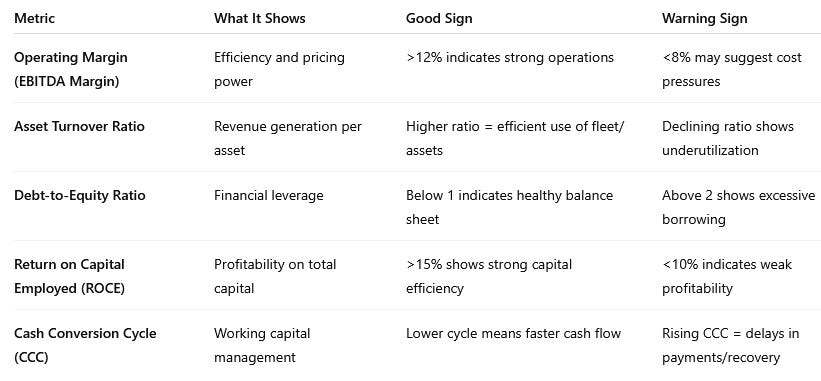
These ratios together reveal whether a logistics company runs efficiently, manages cash well, and maintains a sustainable capital structure.
Major Players
Blue Dart Express – Known for a strong air express network and service quality.
TCI Express – Focused on asset-light operations with consistent profitability.
Delhivery – Technology-driven integrated logistics provider with strong e-commerce presence.
Container Corporation of India (CONCOR) – Government-backed player dominant in rail logistics and container handling.
Future Outlook
The sector is set for transformational growth over the next decade:
National Logistics Policy (NLP) aims to reduce logistics cost to 8% of GDP by 2030.
Green Logistics is gaining attention with EV fleets and sustainable warehousing.
Global Trade Diversification and India’s push to become a manufacturing hub will expand domestic and cross-border logistics demand.
Tech Integration – Blockchain for transparency, AI for predictive maintenance, and drones for delivery may redefine the industry.
In short, the next wave of logistics growth will come from technology, consolidation, and a government-led infrastructure push.
Management
Management Quality
Look for managements with a strong execution record in handling scale and operational efficiency. Leaders who invest in tech, maintain high fleet uptime, and ensure compliance tend to outperform.
Alignment with Shareholders
High promoter ownership (40–60%) and consistent communication signal commitment. Transparent reporting and capital allocation (not over-leveraging) are green flags for investors.
Investor View
Who Should Invest
Long-term investors looking for exposure to India’s structural growth story.
Thematic investors are betting on manufacturing, e-commerce, and infrastructure.
Risk/Reward Profile
Reward: High growth potential with policy and tech support.
Risk: Sensitive to fuel prices, economic slowdowns, and regulatory hurdles.
Investors should prefer companies with asset-light models, efficient working capital cycles, and tech-driven scalability for long-term compounding returns.
Final Thought
The logistics sector is often unseen but always essential. As India transitions from a consumption-driven to a production-driven economy, logistics will quietly determine how fast and efficiently that future arrives.
Thanks for spending time with The Finance Lens! If this helped, subscribe for free to stay up-to-date with our insights. And if someone in your circle could also benefit from this, share it with them—because investing wisdom grows stronger when it is shared.
Great writeup!
Yes True Automobiles and Logistics is next for good returns. Choose good funds to tap entier sector