
Why Inflation Is Falling Overall But Your Grocery Bill Still Feels Heavy
Inflation is cooling, but your grocery bill isn’t; here’s what climate, oil, and supply chains are hiding

Hello and welcome back to The Finance Lens!
There is a strange disconnect happening right now.
On paper, inflation is cooling. Central banks like the RBI are not rushing to hike rates anymore. Macro data looks under control.
But walk into a grocery store in Mumbai, or anywhere in India, really, and the feeling is completely different.
Prices still feel high. Cooking oil still hurts. Vegetables still swing like a rollercoaster. And households are quietly asking: If inflation is falling, why doesn’t it feel like it?
Let’s break this down in a simple, honest way.
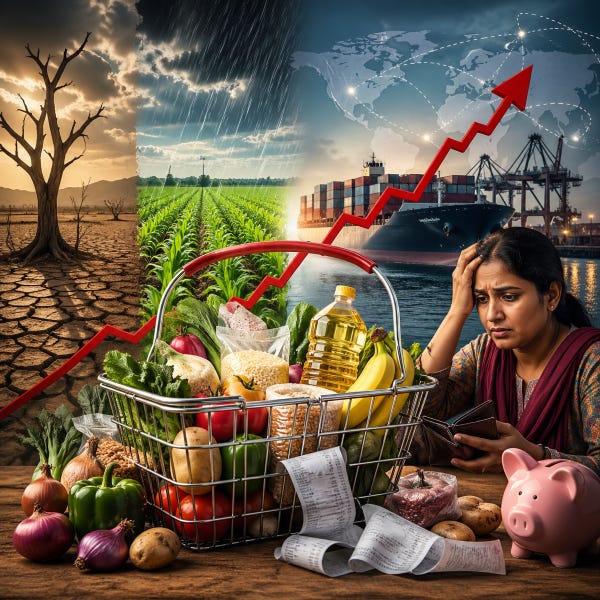
First: Yes, Inflation Is Falling… But That’s the Average
The inflation numbers you hear in news headlines are averages.
They mix everything together:
Electronics
Rent
Fuel
Food
Services
So when prices of some things stabilise or fall (like fuel or certain manufactured goods), the overall inflation number comes down.
But here’s the catch:
You don’t consume “average inflation.”
You consume your basket, mostly food, groceries, and essentials.
And that’s where the pain still sits.
Food Inflation Is a Different Beast
Food prices don’t behave like regular inflation.
They are driven by real-world chaos, not just monetary policy.
Right now, a few things are quietly keeping food inflation sticky:
1. Climate Shocks Are Becoming the New Normal
Unpredictable weather is now a structural problem, not a one-off event.
Excess heatwaves damage wheat and vegetables
Unseasonal rain destroys crops at the harvesting stage
Droughts reduce supply cycles
So even if demand is stable, supply keeps getting disrupted.
Less supply = price spikes, even if everything else is calm.
2. Edible Oil Volatility (The Silent Pressure Point)
India imports a large part of its edible oil needs.
That means:
Global palm oil prices
Soybean supply cycles
Export restrictions from producing countries
All directly hit Indian kitchens.
Even small global disruptions → show up in your cooking oil bill within weeks.
3. Supply Chains Are Still Not “Normal”
We like to think global supply chains recovered after COVID.
But reality is more uneven:
Shipping routes have changed due to geopolitical tensions
Freight costs remain unstable
Export restrictions appear suddenly in key producing countries
This creates friction everywhere, especially in food distribution.
Even if crops are fine, getting them to your local market is not always smooth or cheap.
4. Monsoon Is Uneven, Not Broken; But That Still Hurts
India’s monsoon is not failing overall, but it’s becoming uneven and erratic.
Some regions get excess rain
Some face long dry spells
Crop timing gets disturbed
This creates mismatches:
Surplus in one area
Shortage in another
So prices don’t stabilise uniformly across the country.
So, Why Is RBI Not Hiking Rates?
Because central banks look at the bigger picture:
Core inflation (non-food) is more stable
Growth is still sensitive to higher rates
Financial conditions are already tight enough
So the RBI’s stance is basically:
We see food inflation pain, but we don’t want to break growth over it.
Food inflation is treated as supply-side noise, not something interest rates can fix.
And that’s an important distinction.
The Key Insight Most People Miss
Here’s the real contradiction:
Monetary policy controls demand-driven inflation
But today’s inflation pain is mostly supply-driven
So even if RBI does everything right:
Food prices can still rise
Groceries can still feel expensive
Households can still feel pressure
Because this is not a “money problem” alone.
It is a climate + logistics + global supply problem.
Why It Feels Worse Than It Is
There’s also a psychological layer here.
Food is:
Frequent
Visible
Emotional
You may not notice a 2% drop in inflation on paper, but you will notice ₹10 more on tomatoes.
That’s why sentiment feels worse than the data.
What This Means Going Forward
If you zoom out, the pattern is clear:
Inflation headline → gradually cooling
Food inflation → structurally volatile
Household experience → still painful, uneven
This gap between “data” and “daily life” is likely to stay for a while.
Unless:
Climate patterns stabilise (unlikely short-term)
Supply chains become more resilient
India improves storage, logistics, and crop planning
Final Thought
We often assume inflation is one single number.
But in reality, it is two different worlds:
One world lives in RBI reports and CPI charts.
The other lives in kitchens, markets, and weekly grocery bills.
Right now, those two worlds are not moving in sync.
And that’s exactly why people feel confused and, honestly, a bit frustrated.
Because inflation may be falling.
But life doesn’t feel like it is.
If you want to go deeper every week…
I break down these exact shifts, inflation, RBI moves, sector trends, and where the real opportunities are building in my Saturday newsletter.
It’s not noise. It’s what actually matters for markets and your money.
You can check last week’s edition here: https://theequityecho.substack.com/t/weeklynewsletter
And if you want to understand money beyond charts…
I have just started a new Sunday publication called Money In Real Life, where I unpack money behaviour, daily financial decisions, and the psychology behind why we spend, save, or get stuck.
It’s not about tips; it’s about understanding how money actually works in real life.
I have only posted one article so far, but a new one drops every Sunday.
You can check it out here.

Until next time,
-Smita 💚
Thanks for spending time with The Finance Lens! If this piece helped you, tap the ❤️, share it, or repost it on Substack; it really helps our insights reach more thoughtful readers like you. If you haven’t already, subscribe for free to stay up to date on our latest stories and insights. Because investing wisdom grows stronger when it is shared. 😊